
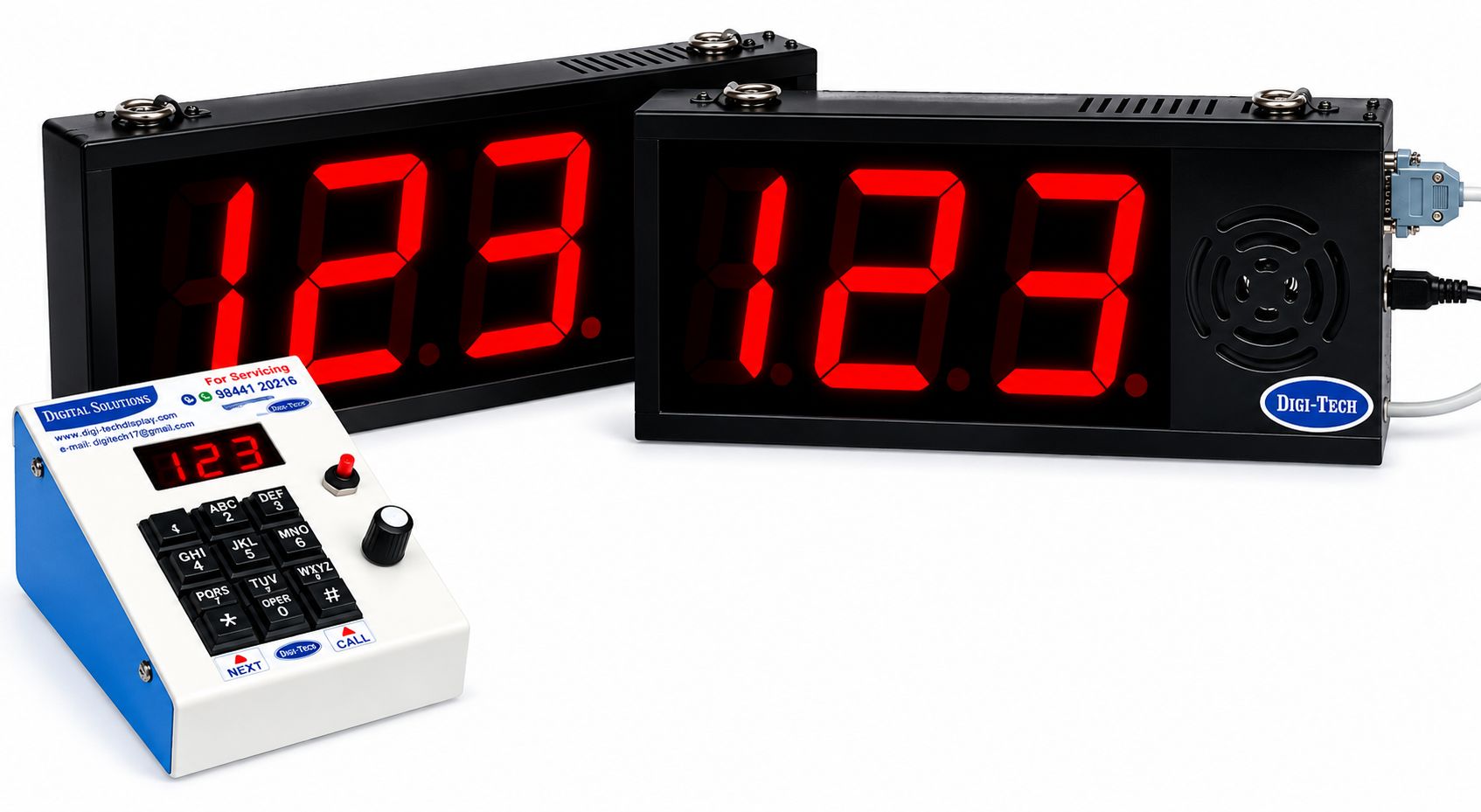
Walk into any bank, hospital OPD or government office in India today and you will see it: take a token, watch the LED board, walk up when your number is called. It is so ordinary now that no one wonders where it came from. The answer, in large part, is a workbench in Bengaluru — and a self-made engineer who was building these systems by hand years before the company that made them famous was even registered.
1994–1995 — a one-man workshop, and the first bank displays
Before DIGI-TECH existed as a registered company, its founder A.N. Venkatesh — an Electronics & Communication engineer who began as a sales executive at PAM Networks Limited — started his first company in 1994: MEI (Mysore Electronics Industry) Marketing and Services, opened the way many Indian entrepreneurs did then, simply with a bank account at Sree Subramanyeswara Co-operative Bank. He ran everything himself — sales, marketing, production and engineering. At the time, almost every electronic system in India was imported; Venkatesh's conviction was that India could design and manufacture its own.
In 1995, at MEI Marketing and Services, he designed and built a complete acrylic-fronted interest-rate display board and supplied it to State Bank of India's J.C. Road branch in Bengaluru — and by that same year he was hand-building electronic token displays and had already won his first clients. When DIGI-TECH was registered as a proprietorship on 26 January 2001, the token display he had been building since the mid-1990s became its founding product. It is fitting that the token display — the most visible, public-facing piece of queue management — is quite literally where the company began.
The problem: forged paper tokens, lost plastic tokens, and a number shouted across the hall
Before any of this, managing a queue meant one of a few unreliable methods. Many counters handed out handwritten paper tokens — easy to smudge, easy to copy and easy to forge, so the fairness of the whole queue could not be trusted. Others switched to reusable plastic tokens, which stopped the forgery but created new problems: they went missing, and customers routinely carried them home, so the counter simply ran out of tokens. And in almost every case there was no voice announcement at all — a staff member called the next number out loud across a noisy, crowded hall, which people missed, mistook or argued over.
Those everyday frustrations — forged paper slips, lost plastic tokens, and numbers shouted over the din — were exactly the pain points A.N. Venkatesh set out to solve. A printed, sequential, tamper-proof token from a machine, a public display that clearly showed the number being served, and an automatic voice announcement removed all three problems at once. That is the need the integrated Queue Management System was built to meet.
Early 2001 — the integration that created the queue management system
A token display on its own tells a waiting hall which number is being served. The leap came when Venkatesh integrated a token dispenser with the token display — so a visitor could take a printed token from a machine, and the board would call it at a counter. That integration is, in essence, what we now call an electronic Queue Management System (QMS).
DIGI-TECH was among the first companies in India to engineer a queue management system this way — turning a standalone display into a complete take-a-token, watch-the-board, walk-to-the-counter workflow. What is a standard fixture in every bank, hospital and government office in the country today began, in large part, as this early-2001 innovation.
Why this matters
Most vendors selling queue management systems in India today assemble them from traded modules. DIGI-TECH did not adopt the QMS — it helped originate the category in India, and has engineered every layer (token display, dispenser, controller, calling units, software) in-house ever since.
2003–2004 — queue management for State Bank of India
When State Bank of India introduced its single-window banking concept, it needed to manage the queues that came with it. DIGI-TECH was the company chosen to design, develop and implement the electronic queue management system for SBI — the purchase orders from 2003–2004 are still on record with us.
The first deployment was at SBI Kumaraswamy Layout, followed by SBI Church Street and SBI Jayanagar — among the first electronic QMS installations in Indian retail banking. Tokens were printed on paper at this stage; DIGI-TECH went on to engineer its own token-printer mechanisms in-house, removing dependence on external printer suppliers. From SBI, the same architecture extended to State Bank of Mysore, Travancore and Hyderabad, and then to Corporation Bank, Vijaya Bank, ING Vysya and Syndicate Bank.
25 years on — still built in-house
Today the company is Infra DigiTech Pvt Ltd — ISO 9001:2015 and CE certified, a DPIIT-recognised, bootstrapped and debt-free manufacturer — but the DNA is unchanged. The token display, token dispenser (push-button, POS and touchscreen kiosk) and complete queue management system are all still designed, engineered and manufactured in Bengaluru, by the company that helped create the category in India. DIGI-TECH and DIGI-TECH Solutions continue to operate alongside Infra DigiTech today.
Explore the products that started it all — the Token Display System, the Token Dispenser and the complete Queue Management System, engineered in India since 2001.
View the Queue Management SystemFrequently asked questions
Who invented the queue management system in India?
The electronic queue management system as it is used in India was pioneered by A.N. Venkatesh and DIGI-TECH (now Infra DigiTech Pvt Ltd) in Bengaluru. Venkatesh was hand-building electronic token displays by 1995 at his first company (MEI Marketing and Services, founded 1994), and in early 2001 — after registering DIGI-TECH — he integrated a token dispenser with the display to create the integrated queue management system, among the first companies in India to do so.
When did DIGI-TECH build its first queue management system for a bank?
DIGI-TECH designed, developed and implemented the electronic queue management system for State Bank of India's single-window banking in 2003–2004 — the first deployments were at SBI Kumaraswamy Layout, Church Street and Jayanagar in Bengaluru, among the first electronic QMS installations in Indian retail banking. The purchase orders from that period are on record.
Is DIGI-TECH the same company as Infra DigiTech?
Yes. The business began as DIGI-TECH (Digitech) in 2001, traded as DIGI-TECH Solutions, and was incorporated as Infra DigiTech Pvt Ltd in January 2026. Same founder, factory, team and products — and DIGI-TECH and DIGI-TECH Solutions continue to operate alongside Infra DigiTech Pvt Ltd today.
What was DIGI-TECH's first product?
The Token Display System — the LED board that shows the token currently being called at a counter. A.N. Venkatesh was hand-building token displays for clients by 1995 at his first company (MEI Marketing and Services), and it became DIGI-TECH's founding product when the company was registered in 2001.