
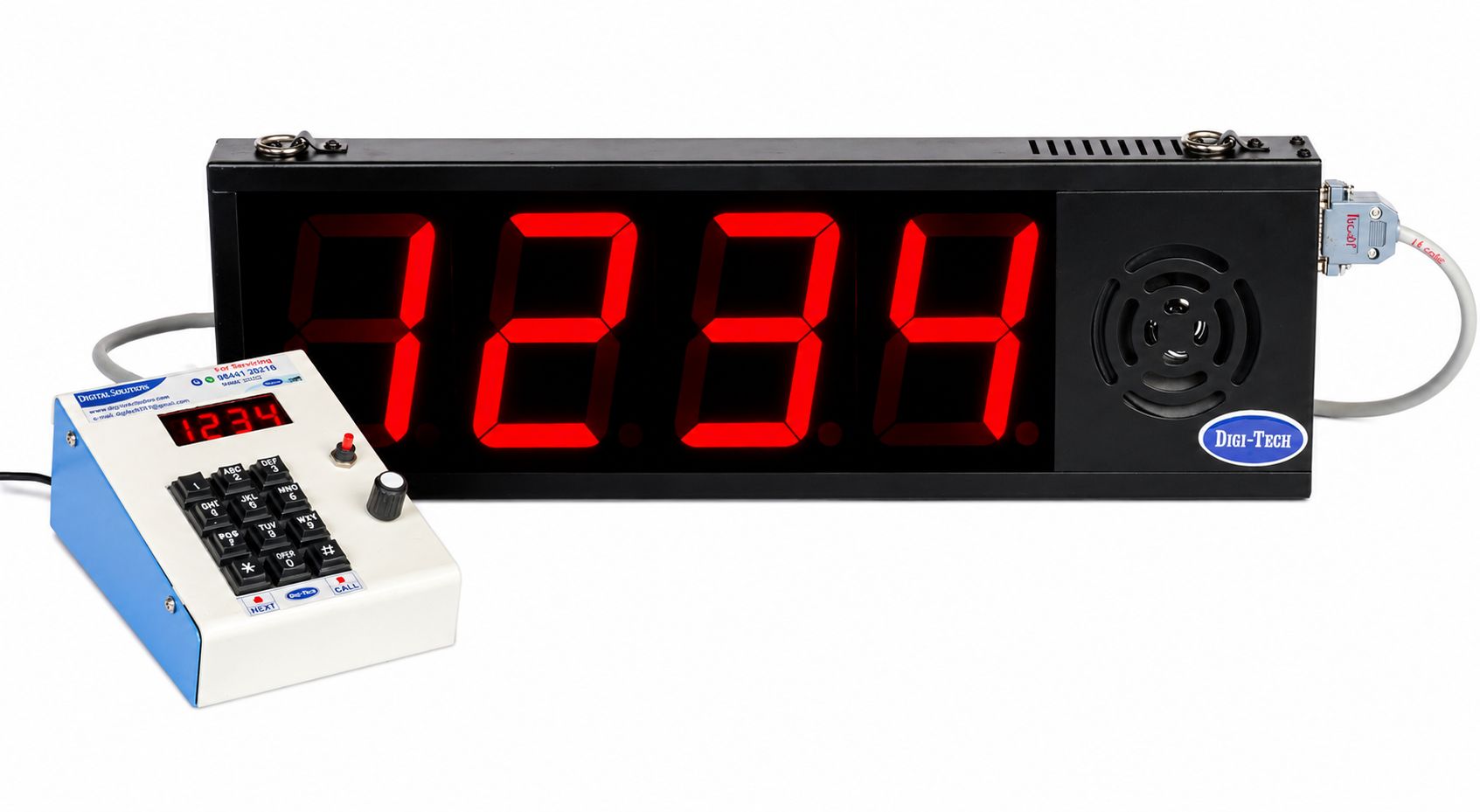
A token display system is the LED (or LCD) board that shows the currently-called token number and counter at a bank, hospital OPD, pharmacy, government office or retail desk. It is the visible, public-facing half of queue management — the part every waiting visitor actually watches. This guide explains the types of token displays, where each fits, the wired-vs-wireless decision, how the display works with a token dispenser and a full queue management system, and what decides the price in India.
What is a token display system?
At its simplest, a token display system shows 'now serving' information to a waiting hall: the token number being called and, usually, the counter or room it should go to, along with a chime or voice announcement. A visitor takes a token, watches the display, and walks up when their number appears. It removes crowding at the counter, ends the 'who is next?' confusion, and enforces a fair first-come-first-serve order.
Token displays range from a single 3 or 4-digit LED panel at one counter, to multi-counter boards showing several counters at once, to large central summary displays in big halls. They can run standalone with a simple handheld keypad, or as the display layer of a full queue management system with automatic ticket dispensing and counter calling units.
Types of token displays
- Single-counter token display — one 4-digit LED panel per counter showing the token currently called; ideal for a single doctor's room, a pharmacy window or one bank counter.
- Sequential / multi-window display — shows the current token plus the next few in line (e.g. a 3-window sequential board) so visitors get a heads-up; common at restaurant parcel counters, pharmacy pickup and retail order collection.
- Multi-counter display — a single board showing token + counter for several counters at once; standard in bank branches and hospital billing halls.
- Central / summary display — a large overhead board summarising every counter in a big hall, airport or government service centre.
- Voice + display — most displays pair with a chime or multi-language voice announcement so the call is heard as well as seen.
Where token display systems are used
Anywhere people wait for a turn at a counter. In banks and NBFCs, token displays at each teller and a summary board keep branch queues orderly and audit-friendly. In hospitals and clinics they run OPD registration, billing, pharmacy and sample-collection queues, and doubles as a doctor / room display outside consultation rooms. Government and public-service offices use them at passport, Aadhaar, RTO and municipal counters. Pharmacies, retail order-pickup, telecom stores and service centres use them at collection and service desks.
Wired vs wireless token displays
Wireless token displays connect the calling keypad (or dispenser) to the display over RF, so there is no cabling between the counter and the board — you only need a power point at the display and the keypad. They install same-day, are perfect for existing halls and rented premises, and are the default for most single and small multi-counter setups. The trade-off is battery upkeep on handheld keypads and planning around RF range in very large or RF-heavy buildings.
Wired token displays run a data cable from the controller to each display. They suit new construction where cabling can be planned, very large halls, or sites that prefer zero wireless dependency. Cost per point is similar; the advantage is rock-solid links over long distances. Many real deployments are hybrid — wireless where retrofit is needed, wired on the long central-board runs.
Quick rule of thumb
Retrofitting an existing branch or ward? Go wireless. Fitting out a new building or a very large hall? Consider wired or hybrid. Either way, insist the same controller supports both, so you can mix and extend later without replacing hardware.
Token display, token dispenser & full QMS — how they fit together
These three are layers of the same system, and you can start with any one: The token dispenser issues the physical ticket (push-button, POS or touchscreen kiosk). The token display shows which token is being called at which counter. The full queue management system ties them together with automatic counter calling units, supervisor dashboards, wait-time reporting, token forwarding across departments and multi-language voice. A small clinic might run just a single-counter token display with a handheld keypad; a large hospital runs dispensers, displays and calling units on one QMS back-end. Because it is one architecture, a standalone token display today can be upgraded into a full QMS later without throwing anything away.
What decides the price of a token display system in India
- 1Number of counters / displays — you pay per display panel and per calling keypad
- 2Display type — single 4-digit panel vs multi-window sequential vs large central summary board
- 3Digit size and colour — bigger digits and multi-colour boards for large halls cost more
- 4Wired vs wireless, and cabling runs for wired installations
- 5Voice announcement and number of languages
- 6Standalone vs integrated with a token dispenser and full QMS
- 7Buying direct from the manufacturer vs through a reseller — we quote factory pricing, same day
We do not publish a single price because a one-counter clinic display and a 12-counter bank hall are very different systems — but standalone token displays are among the most affordable products in the queue category. Send your counter count and hall size and you will have a factory quotation the same day.
Buyer's checklist
- How many counters need a display now, and how many might you add later?
- Single current-token display, or do visitors benefit from seeing the next few tokens?
- Wired, wireless or hybrid for your building?
- Is voice announcement needed, and in which languages?
- Will you want automatic dispensing, calling units and dashboards later (i.e. a full QMS upgrade path)?
- Is the manufacturer ISO 9001:2015 & CE certified with local service and long-term spares? (ours are — since 2001, in Bengaluru)
See our standalone Token Display System — 4-digit single-counter and 3-window sequential variants, wireless, plug-and-play — engineered and manufactured in Bengaluru.
View the Token Display SystemFrequently asked questions
What is a token display system?
A token display system is the LED or LCD board that shows the token number currently being called, and usually the counter or room to go to, at a bank, hospital OPD, pharmacy, government office or retail desk. Visitors take a token and watch the display for their turn, which removes counter crowding and enforces a fair first-come-first-serve order. It can run standalone with a handheld keypad or as the display layer of a full queue management system.
What is the difference between a token display, a token dispenser and a queue management system?
They are three layers of one system. The token dispenser issues the physical ticket (push-button, POS or touchscreen kiosk). The token display shows which token is being called at which counter. The full queue management system ties them together with automatic counter calling units, dashboards, wait-time reporting, token forwarding and voice. You can start with just a token display and upgrade to the full system later on the same architecture.
Should I choose a wired or wireless token display?
Choose wireless for existing branches, wards and rented premises — it installs same-day with no cabling between counter and board, and suits most single and small multi-counter setups. Choose wired (or hybrid) for new construction, very large halls, or sites that want zero wireless dependency. The best systems support both on one controller so you can mix and extend later.
Where are token display systems used?
Anywhere people wait for a turn at a counter — bank and NBFC branches, hospital OPD/billing/pharmacy/sample-collection queues, doctor and clinic room displays, government and public-service counters (passport, Aadhaar, RTO, municipal), pharmacies, retail order-pickup, telecom stores and service centres.
How much does a token display system cost in India?
Price depends mainly on the number of counters/displays, the display type (single 4-digit panel vs multi-window vs large central board), digit size, wired vs wireless, and whether voice and full QMS integration are included. Standalone token displays are among the most affordable products in the queue category. As the Bengaluru manufacturer, Infra DigiTech provides a same-day factory quotation.